Showing posts with label pond. Show all posts

Monday, January 19, 2015

Observations While Running

While out for my regular aerobic exercise, as I ran along the edge of our pond, observed a bald eagle swoop over the pond, then get chased away by one or more crows, one of which followed at a respectful distance as the eagle reversed course and flew away.

Further on, I encountered five large downed trees, a hemlock and four Doug-fir, along the trail through our nature preserve. The wind storm we had three nights ago did more damage than I imagined. Later I also saw a large cedar toppled a few blocks from our house. Our crews here are fast - the trees were sectioned and removed from pathways and roads by the time I saw them.

Toward dusk, the eagle returned and rested in a fir across the pond from our deck. At such distance and low light, no decent image was possible with my equipment and skill level, but I captured a somewhat good likeness.

Saturday, January 3, 2015

Heron's Late Lunch

The heron was wading in the pond in the midst of fir twigs that had accumulated on the surface after strong winds some days ago. In the late afternoon sun, his patience was impressive.
The Dream
Comes True

A ways away, a common merganser was floating around with no apparent worries.

Monday, December 29, 2014

Fish Feeders Unite

The kingfisher was joined today by a great blue heron and a common merganser.


Tuesday, December 23, 2014

Belted Kingfisher Plying The Pond

Not much action on our pond this fall. The gadwalls and ring-necks have left for greener ponds, leaving a couple of bufflehead pairs and a couple of mallard pairs. This weekend, a kingfisher spent an hour or so at our end, flitting from tree to tree and occasionally diving into the water, to no avail that I detected.

There are ~90 species of kingfisher; most are stocky, medium-sized, brightly colored birds, including the Kookaburra. Along the American Pacific Coast, the Belted Kingfisher is indigenous. It is classified as a water kingfisher, one of three families. I have observed them from Newport Bay in SoCal to the northern Puget Sound. Their song is a loud, mechanical rattle, like the ratchet mechanism on a large fishing reel.

They are somewhat skittish, hard to get close to. These shots were from around 30 yards to 50 yards away on a gray day, a tough assignment for my hand-held 400mm f5.6 lens. This bird landed twice in the grand fir alongside our rear deck, but I was unable to get outside without causing him to fly away

Thursday, October 16, 2014

Good Things Come To ...

Mr. Ringed-neck is a stud. Two females joined him today and they are now their own social group.


OOPS: It's two days later and Mr. Ringneck is apparently a stud-not. The females have moved on to greener pastures and stud-not is back hanging with the Mallardos, cooling his bachelor heels.

Tuesday, October 14, 2014

Substitute Flock

The gadwall pair were apparently just passing through. But for the last month, the resident mallard pairs have accepted a lone male ringed-neck duck into their social group. Perhaps it will be his first mating season. In any case, he remains here awaiting a mate.


Thursday, October 9, 2014

Back In The Loop

Two winters ago, Gadwalls were the dominant species overwintering on our pond. Last year there were none seen. This week a pair returned. Perhaps we are back in their loop, a comforting thought.


Friday, June 6, 2014

Duckling on Menu for Osprey

I was sitting on the deck with Chico, enjoying the afternoon at the pond. An osprey circled the pond and landed in the fir tree next to our deck.

I grabbed the camera for an ill-exposed snap before it dove to the pond, where a mamma mallard was cruising with her babies. Mamma put up a huge fuss, squawking and flapping her wings, but in a flash, the osprey was on top of them with a splash.

This seems unusual behavior, because the osprey diet is 99% fish. But the fish in our pond are smallish and few, and a baby duck might appear an easy snack. From the fuss by the ducks on the water, it seems clear they considered their young to be targets. Later, a mamma duck was circling along the bank of the pond, plaintively calling for her young from amongst the reeds and grasses. So it is likely that some got disappeared.

Chico didn't seem too concerned, although the osprey interrupted my feeding him some grass seed (long grass stems from the lawn gone to seed).

Aside: David gave me a book about budgies for my birthday. I read that their natural diet is grass seed. Sure enough, Chico goes nuts for the stuff and knows just what to do with it.

When the pond excitement was over, Chico and I resumed where we left off on the grass stems.

Later, Debby saw an osprey land in a fir across the pond. It was a long distance away, but the late afternoon lighting and darker background were photographically easier to work with. A mamma mallard and ducklings were still in the center of the pond, but tree bird seemed uninterested. Eventually, two crows chased it off.

Saturday, May 24, 2014

Pond Life - Spring 2014

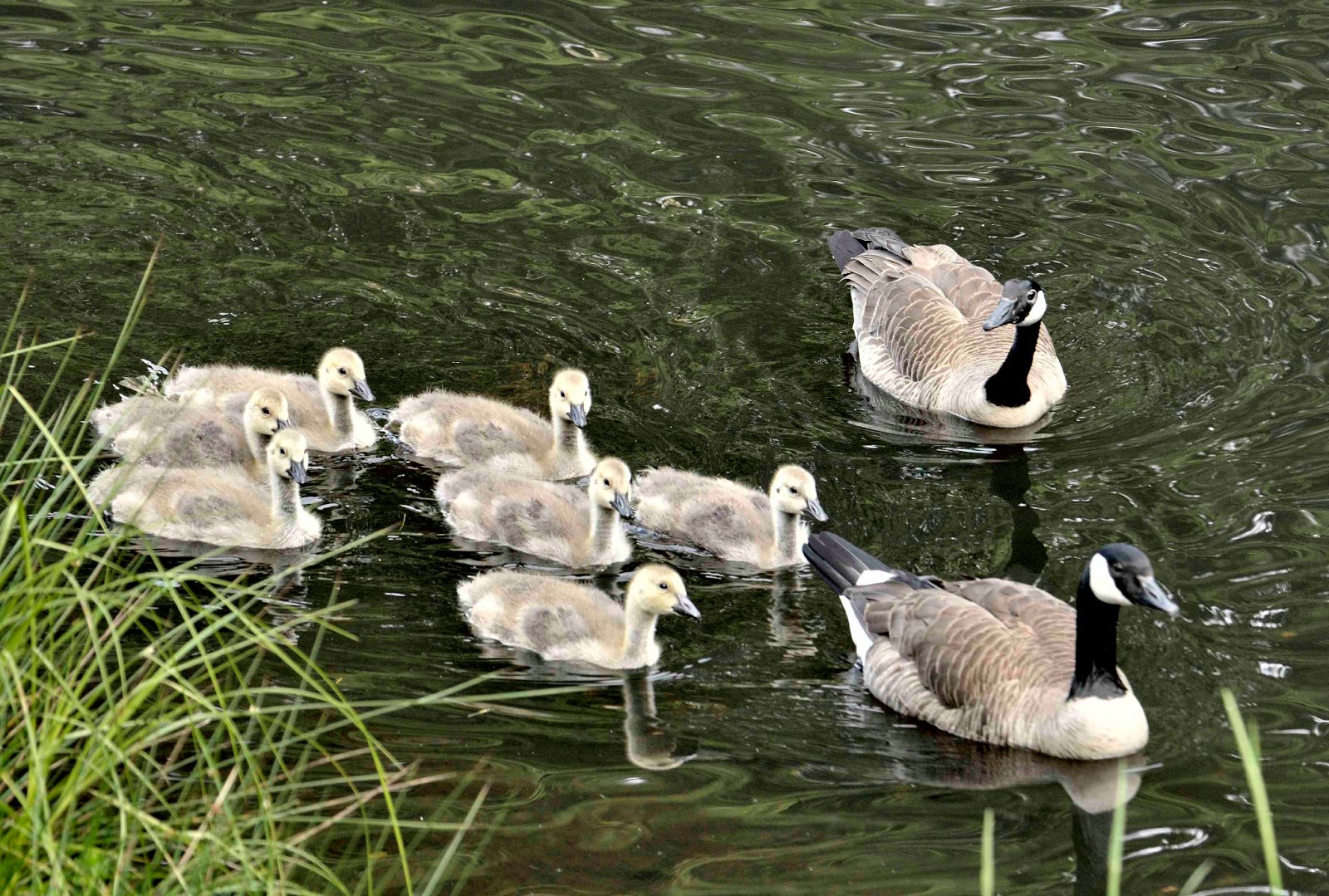
This spring, five ducklings and six goslings seem to be the haul that avoided the neighborhood crows and cats. This morning, the goose family was storming our bank to eat grass and flowers. As the photographer came on the scene, the geese steamed off a respectable distance and then pappy could be seen standing guard.


The pond's goose brood last year was seven, but it was a month later.

Sunday, November 24, 2013

Winter on the Way - 2013

Happy belated pumpkin day.
Our first frost usually happens around November 1st. This year it came on Oct 28th.
Mallards still frequent the pond. They are the only waterfowl here in the late summer and early autumn.
The first Buffleheads were seen to return on November 6th. A wigeon visited the pond on November 24th to wish us happy gobble-day.
Our first snow day was December 20.


Sunday, July 21, 2013

Mallard Diver

There are two sorts of ducks: divers and dabblers (think head and shoulders under water, tail high in the air). According to the authoritative ornithology site at Cornell, mallards are of the dabbling sort who "almost never dive". So I feel privileged to have observed a mallard who almost never dabbles. It is a juvenile who is always accompanied by his mother, who doesn't dive. What might account for this precocious diving juvenile?

He was too young to have observed the diving ducks on the pond before they left in spring. Perhaps he is a young iconoclast duck. Or perhaps diving preceded dabbling on the evolutionary vector and his primitive brain is reasserting itself. Or perhaps he is cross-breed of some type.

His diving motion is identical to the divers we have seen on the pond, very smooth. He stays under water for around 7 seconds and moves perhaps 10 feet before resurfacing. While down, he pushes his bill through the soft sediment on the pond bottom. He seems an expert underwater swimmer. It appears his ability comes from his genes.

Here he is on a dive, then with something he dredged from the bottom, and lastly his mother, who just floats nearby wondering whose kid this is?

Update: This afternoon, every mallard on the pond is diving. Clearly, this is a standard, if secondary, behavior of mallards. I wonder if the juvenile's behavior was an influence on the others; mallard see, mallard do. Perhaps conditions on the pond do not provide enough food for dabblers this summer. The pond has been treated with an aquatic herbicide and the shallow parts don't have much vegetation right now.

In other pond action, we have had at least two bald eagle visits. When spotted, the pond mallards go berserk, squawking loudly and in unison as she makes her lengthwise pass over the pond. She doesn't slow and try to hover, just swoops across at about 15 feet above the surface. Eagles take fish and ducks and anything easy, including carrion. By the time I hear the ducks and get out to watch, she is just leaving, so haven't seen much of the action to date.

Thursday, July 18, 2013

Modern Dinosaur Studies

Sitting partway up a Douglas-Fir, baby dino alternately preened and surveyed the pond. After an apparent small sight or sound of motion, all energy was concentrated on getting back down. But contrary to the expression of agitated vectoring, this was no quick dive, just a relaxed glide.
On the ground, attention was focused on several areas at pond's edge that instinct suggested might harbor a meal. Extreme patience was evident on the stalk, as motion slowed while approaching the target. The last two steps took about 10 seconds each, extreme slo-mo. Then rigid attention for up to half an hour, not a sign of movement.
After the score, dino took a few moments to swallow, then enjoyed a relaxed stroll around the pond.

Sunday, June 30, 2013

June Pond

The pond transforms in summer. Most species left by April. Mallards and Canada geese are finishing with their broods and the summer patchiness of pond scum gives a new look, an acquired taste.
Fish, species unknown, have been spotted, about 8" long I'd guess. As we watched, one of a group of four suddenly shot up and bit the foot of a mallard sitting on the surface. The duck squawked and flew a foot or two before resuming its nap.

We have a bullfrog that serenades day after day. Fortunately, it is not too loud inside, so sleep is not disturbed.

A group of four or more swifts came a couple of weeks ago and were here for several days, constantly flitting from seemingly nowhere to our blue spruce, then back out in an endless looping. Never did get a good look at one before they left.

Today a great blue heron swooped in and dipped its feet in the pond, then at the sight of the big meanie coming its way, swooped off again down the pond.

 For anyone needing some additional interest in their lives, we recommend they adopt a pond somewhere.

Thursday, April 25, 2013

They Need A Bigger Nest (Maybe Bigger Pond?)

This evening I happened to look over the rail of the deck down to the edge of the pond below. When did all this happen, right under our noses?

They had noticed my presence by the second image and she had covered up the exposed chicks. The dad is still in the picture here, although typically they are reported to desert the brood after incubation is complete.

Postscript1

I wondered if my brief intrusion on their family scene had messed them up at all, but this morning they were all motoring across the pond with chicks splashing and paddling furiously with wings and feet to keep up with the parents. There are 15 ducklings, making this at the extreme large end of Mallard clutch size. The female typically lays eggs weighing in total over half of her body weight.

Here are three more images, showing the duck equivalent of our emergency duck and cover drills. In the first, they have just noticed the big meanie on the deck, and mama gives her best 'follow me and circle the wagons' charade. In the second, they are seen streaking for cover, mama using her bill in good herding-duck fashion to keep the babes in line. In the third, mama instructs them how to spread out and disappear into the grasses, their 'hide' on the other side of the pond (away from the big meanie). You might imagine the dad would be making a display, attracting attention away from the brood. Nah. He's on his sabbatical, floating along oblivious to the excitement.

Postscript 2

Mama keeps the ducklings hidden in the grasses for long periods, but today after three days of no sightings, she was observed calling them out to her. They paddled as a group out of sight to the far end of the pond.

It's not clear what they eat or how they are fed, but perhaps, even at this small size, are self-sufficient at grabbing high-protein aquatic arthropods in their grasses.

Nature is impressing us through the apparent competence of this duck pair to handle the stresses of raising a large brood on such a small pond. Fortunately, predators seem scarce at our pond. We've observed no large snakes, only a couple of raptors, no racoons or opossums. There is a yellow cat that spends a lot of time at water's edge near our yard, but I've never seen it go to the other side by the duckling hide.

Postscript 3

Yesterday I saw the mama with only six ducklings on the pond and was concerned. Today, seven days after first sighting, she's back and there appear to be twelve ducklings with her. If this is the same mama as we originally saw, I'm thinking the crows must have taken the others, although I'm not sure how they got at them. There have been several crows taking more than usual passing interest toward the edges of the pond. The yellow cat may still be a suspect also.

Wednesday, April 17, 2013

Spring Comes To Cherry Pond

I had been adding new material to my original Cherry Pond post, but decided to bring the new material up to this new post.

The pond greeted us on the first day of spring with a frosting surprise.
I briefly thought of joining this year's class action suit against that fraudulent expert witness Punxsutawney Phil, who appears to have pulled a fast one on us this year. However, most snow melted by sundown, so we'll let Phil off the hook once again.

Also that night, the snow seemed to bring a newcomer to the pond area, the first owl I've heard since moving here. It was an 8-hoot owl (say 'who cooks for you' twice, with slight emphasis on you), also known as a Barred Owl, an eastern newcomer to the area that is becoming a threat to our native Northern Spotted Owl. He was quite vocal between 11PM and midnight, and I fell asleep to repeated calls every 30 seconds or so. But apparently, no female answered, so his was a one night concert.

An April surprise brought a Canada Goose to the railing of our deck, remaining there for at least 15 minutes and allowing me to open the door ten feet away and take photos. I thanked the goose, and it flew off to answer the call of some geese at the other end of the pond.
The goose had attracted my attention via a repeated knocking noise, waking me and beckoning me to get out of bed and answer the back door. I truly am a fully rational being, but a primal, shadowy thought, from seemingly nowhere, flitted across my consciousness: what spirit associated with this location might have returned to visit in the shape of a goose? I can easily imagine how my prehistoric Germanic ancestors were motivated to devote considerable spiritual energy toward such augury, often involving birds. Will such workings of the human brain ever be fathomed? Omen, omen, speak to me; should I play the lottery?

A further surprise came that evening, when the Barred Owl's return was noted, even closer than before, so that Debby could hear it also.

Monday, November 19, 2012

Our New Home on Cherry Pond

Our new house sits on the SE corner of Cherry Pond, our water (retention) feature. Our back yard is a large deck facing ~NNW, perhaps 5m above the pond.


The pond hosts several species of ducks (mostly just passing through I think, but the first three below have been here every day for our first winter here). The following pictures were mostly taken from our deck. Apologies for the blurry ones (light is getting low here in the NW in the morning); the blurry ones will be replaced as soon as better are available.

Mallard (daily)

Gadwall (Daily Autumn-Spring))

Bufflehead (daily)

Eurasian (Common) Teal (Winter)

Green-winged Teal (Autumn-Winter-Spring)

Ring-necked Duck(Autumn, Spring)


Lesser Scaup (Autumn), Spring)

Hooded Merganser (Autumn)

Common Merganser (Autumn)

 Canada Goose (Autumn, Spring)

Also observed: American Wigeon, Osprey

Postscript

The pond changes its characteristics in winter.

Pictured above is our one snow flurry of an otherwise Snowless in Seattle winter.